Posted by Michael Pinto on Apr 27, 2013 in Science
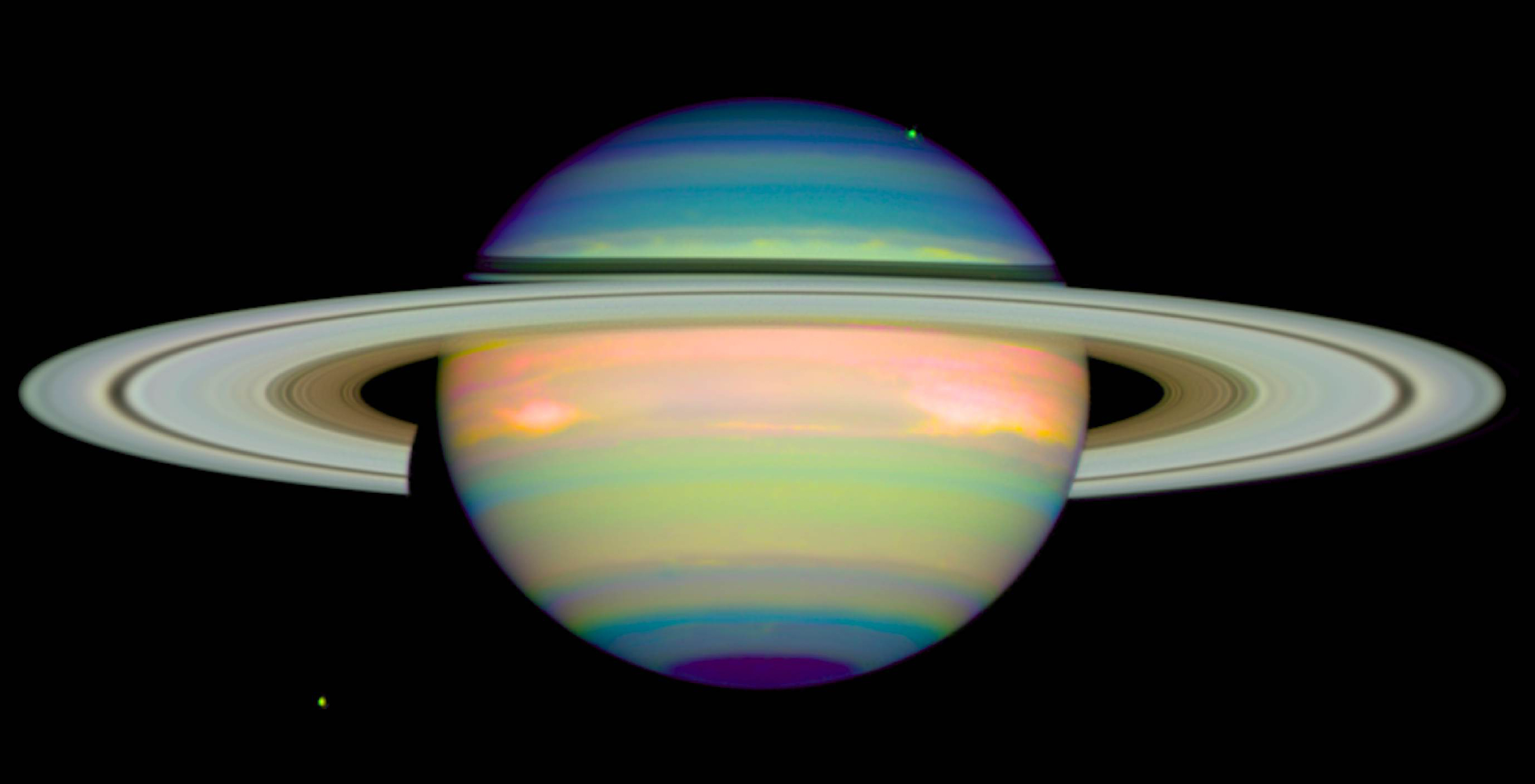
If you look outdoors tonight you’ll see Saturn in opposition, which means that it will be exactly opposite the sun as seen from Earth. To find saturn when the sun sets in the west, look for Saturn to rise in the east when the sun is farthest below the horizon then Saturn will reach its highest point above the horizon. Read more…
Posted by Michael Pinto on Jul 16, 2012 in Science
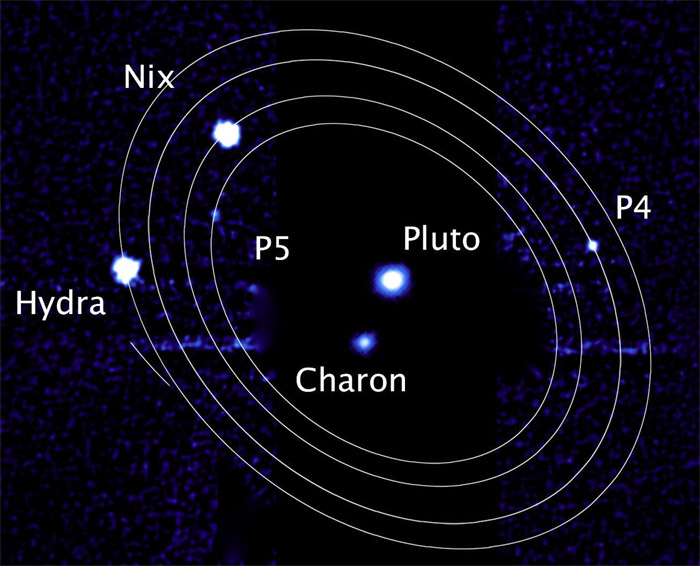
A few years ago Pluto suffered the public humiliation of being demoted from being a planet, but perhaps things are looking up for the little guy: Last week a fourth moon was discovered to be orbiting around Pluto and Charon which is starting to make some folks feel that Pluto may in fact be a binary planet. Although there is still a larger debate on where to draw a line between double-planet and a planet–moon system, so poor Pluto may have to wait a bit longer…
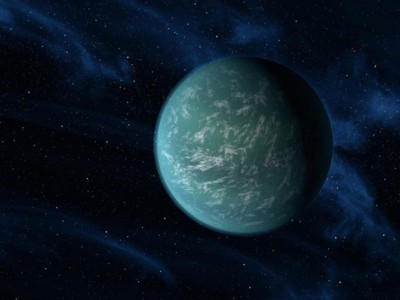
Two years ago, NASA’s Kepler space telescope identified the planet designated Kepler 22B — a super-earth orbiting a yellow dwarf similar to our sun. Read more…
At this year’s Christmas Toy Fair, Sega’s toy division showed off their officially licensed Star Wars R2-D2 Homestar Planetarium — a R2-D2-shaped projector capable of displaying over 10,000 stars on the ceiling or wall of your choice. Despite that hefty number, the actual unit isn’t that big, only running on four AAA batteries. The projection only spans about five to seven and half feet depending, with a circumference of almost six feet around, perhaps making it more ideal for bedroom situations. Still, you have to admit the thought of having your own mini-R2 unit spitting the stars onto your ceiling would be sweet. It even includes the Death Star for good measure. The unit hit Japanese stores back in mid-September, but if you want to get your hands on one, you can always import it. It’ll cost ~$87 USD before tax, so it isn’t cheap, but importing toys rarely is.
In this wonderful short video clip science writer Bill Bryson talks about how amazing it is that over the course of just a few short billion years we’ve gone from a collection of atoms to living life forms. Bryson also points out that it’s interesting that there is nothing special about the atoms that make up each of us.
Posted by Michael Pinto on Mar 31, 2010 in Science, Tech
This story touched my heart: One of the side benefits of NASA is the amazing images that that the Hubble Space Telescope has produced over the years — however many of these glimpses of the furthest corners of the universe are off limits to the blind. So according to this story reachers at NASA worked with braille experts to create a representation of the Carina Nebula. What I love about the project is that the embossed photo isn’t a literal representation but instead is filled with different symbols which give information on the formation of the nebula itself. Read more…
Posted by Michael Pinto on Oct 23, 2009 in Science
In this video Bethany Cobb does a great job of explaining how astronomers search for planets in orbit of stars. In the full video she further explores NASA’s Kepler Mission and its search for Earth-like planets in other solar systems. Here’s a previous video with Cobb talking about the expanding nature of the universe: Read more…
Posted by Michael Pinto on Apr 27, 2009 in Science
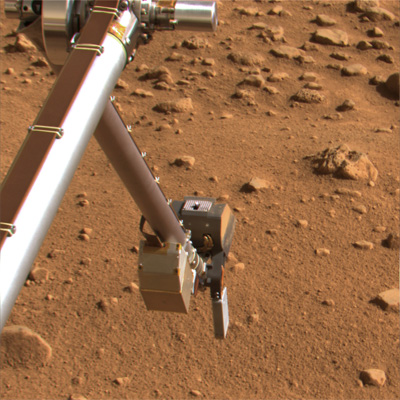
The good news is that Peter Smith who led NASA’s Phoenix Mars Mission predicts that within ten years we’ll find life on other planets — but the bad news for us fanboys with hopes of hanging out with Vulcans and Klingons is that E.T. may be a clump of lowly microbes sitting underneath a rock on Mars. Smith made this prediction during his recent “Journey of the Phoenix” presentation at the University of Delaware which included images from the Phoenix which touched down on the Martian arctic last year. Read more…
Posted by Michael Pinto on Feb 16, 2009 in Science
It was only less than a few weeks ago that we reported that Astrophysicist Duncan Forgan had boldly calculated that there are about 40,000 planets that would support intelligent life — well like a free nerd upgrade Dr. Alan Boss of the Carnegie Institution of Science now claims that our galaxy could have billions of earth-like planets! Boss’s thinking is that each Sun-like star has on average one “Earth-like” planet, although sadly he wouldn’t go on the record like Forgan and take his math to the next level to make predictions about intelligent life. In fact on the negative side (or positive?) Boss feels that many of these planets are in primitive states and are populated by less advanced life forms like bacteria. But up on the up side Dr. Boss thinks that NASA’s Kepler mission might begin to spot earth-like planets in just a few years.
Our galaxy is big, really big — so the odds are in our favor that Earth is not a fluke. Of course this thinking is old news at this point, however what’s new is that astrophysicists are starting to crunch numbers on the subject based upon what we currently know from the field of astronomy. Once such fellow is Astrophysicist Duncan Forgan who has been crunching the numbers based on what we know about the currently discovered 330 known exoplanets. His estimate took into account factors like temperature, availability of water (so yes it’s “life as we know it”) and the size of the Milky Way. Read more…
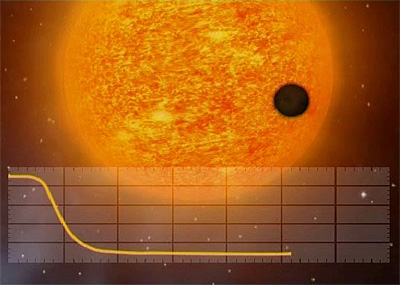
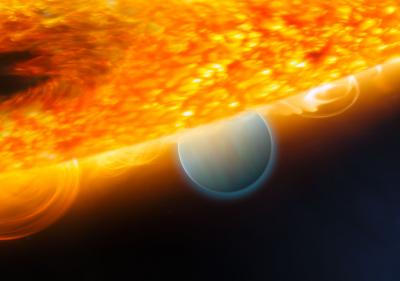
While this planet is about twice the size of Earth it’s amazing to think of the progress that astronomers have made in just the past few years. I wouldn’t be surprised if in the next few years we discovered a solar system that’s similar to own own. This latest exoplanet was detected by looking for a drop in brightness of the parent star as the planet passed in front of the star: During this transit the planet appears as a tiny black dot. There’s some controversy to the exact size of the planet, but to me what’s exciting is that we’re getting better at spotting the small one.
Posted by Michael Pinto on Dec 17, 2008 in Science
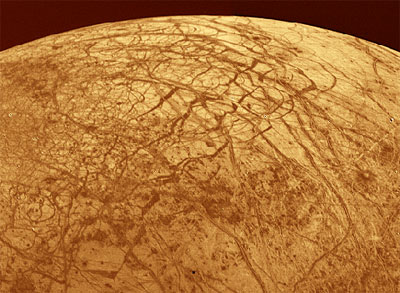
When most scientists thought of the one place in our solar system outside Earth that may support life the common favorite was Titan, but now that honor may go to the Europa the other sister moon of Jupiter. Astronomers feel that underneath it’s icy surface may lurk energetic oceans which due to the gravity from Jupiter would feature tides — a key ingredient to making life possible: Read more…
The Antikythera mechanism is an ancient calculator that was discovered in Greece over 100 years ago, what makes it amazing is that it’s over 2,000 years old and uses similar technology that wasn’t available until the 18th century. But what’s very cool is that scientists have recently reconstructed a working model of the mechanism which was used to calculate the positions of the sun, moon, and the planets: Read more…
Posted by Michael Pinto on Dec 12, 2008 in Science
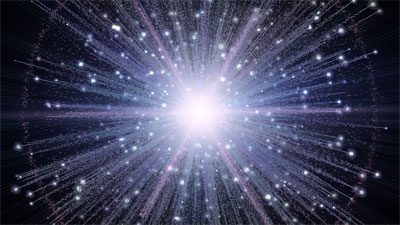
There’s a great article at New Scientist on speculation that the cosmos existed before the Big Bang and that the bang itself was a recycling effect. It seems that scientists are now starting to play with computer simulations to try and determine what a pre-Big Bang cosmos looked like: Read more…
Posted by Michael Pinto on Dec 10, 2008 in Science
It’s amazing how every day we find more and more obvious clues that there may be other signs of life in he universe. This latest discovery shows that astronomers have detected carbon dioxide (a basic requirement for plants to perform photosynthesis) on a Jupiter sized planet. What’s great about this is that someday this technique may used to hunt for hints of life on an Earth like planet: Read more…
Posted by Michael Pinto on Nov 21, 2008 in Science
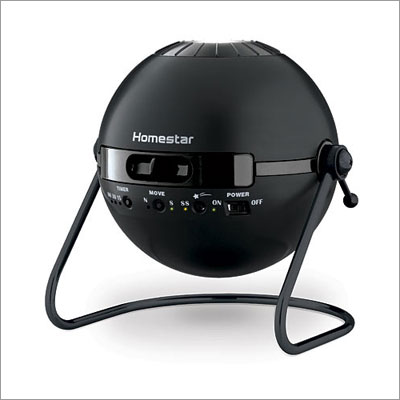
The Homestar Home Planetarium use to only be available in Japan, but now ThinkGeek is about to carry a version designed for the American market. What’s nice about this gizmo is that it can turn any space into a planetarium for the cost of about $160. In fact not only do I think this is the kind of gift to give to an astronomy fanboy (or fangurl) but it would be cool if folks started buying these to give to science teachers at your local school. Read more…
Posted by Michael Pinto on Nov 14, 2008 in Science
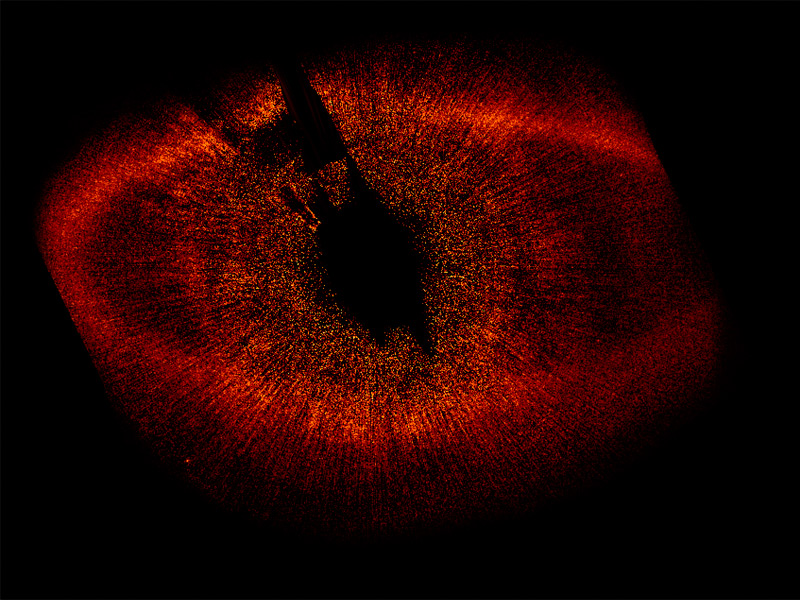
While the photo above looks pretty, it’s no ordinary snapshot — in fact within the red dust is the very first photo of a planet that’s outside of our solar system. Read more…
Posted by Michael Pinto on Oct 31, 2008 in Science
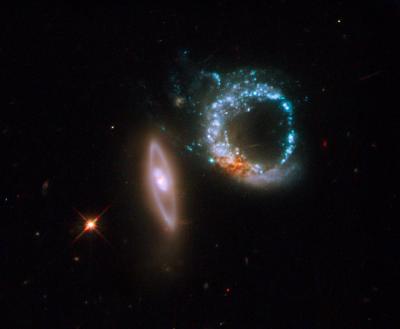
Just a few days after coming back to life Hubble rewards us with the fantastic image above of a pair of double galaxies, and yet like some sad ignored family member will have to wait for a repair mission for a few months:
“The Hubble Space Telescope is working again, taking stunning cosmic photos after a breakdown a month ago. But the good news was quickly tempered by NASA’s announcement Thursday that a mission to upgrade the popular telescope will be delayed at least until May.
A key replacement part that is essential because of the telescope’s failure in September won’t be ready for at least six months. It was the latest twist in the long-running drama surrounding the 18-year-old space telescope — one that initially took only fuzzy photos, then when fixed, provided dazzling and scientifically significant pictures of space, including a new one NASA showed Thursday.”
Posted by Michael Pinto on Oct 28, 2008 in Science
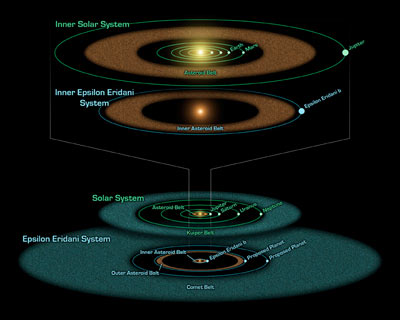
This is an exciting time in astronomy, although as a fanboy what I wouldn’t give to be alive in the era when we’d have the means to visit these places:
“A nearby solar system bears a striking similarity to our own solar system, raising the possibility it could harbor Earth-like planets. Epsilon Eridani, located about 10.5 light-years from our sun, is surrounded by two asteroid belts that are shaped by planets, astronomers at SETI Institute and Harvard-Smithsonian Center for Astrophysics announced today.
But it’s the possibility that currently undetected smaller planets could lie within the innermost asteroid belt that make the solar system intriguing to astrobiologists. “This system probably looks a lot like ours did when life first took root on Earth,” said SETI’s Dana Backman, lead author of a paper on the 850-million-year-old star that will appear next year in The Astrophysical Journal, in a release.”