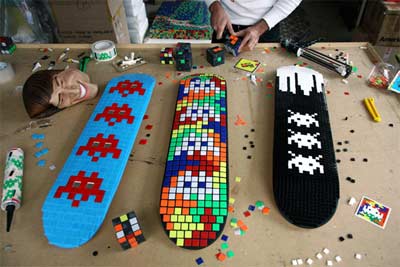
“Paris-based skateboard company Mekanism invited Space Invader—the French graffiti artist known for his mosaics—once again to have his way with their decks. Expanding on the limited edition turquoise and red mosaic print that Invader came up with on their first collaboration (back in ’05), there’s only one per edition and they’re made with actual tiles.”
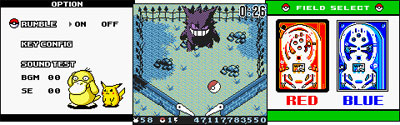
“It’s happening again. You shouldn’t be surprised. You know how successful they’ve been – how deeply ingrained they’ve become. You knew it was only a matter of time before they, the Pokemon, mounted yet another invasion. Now it’s happening again, and you’d do well to prepare yourself.
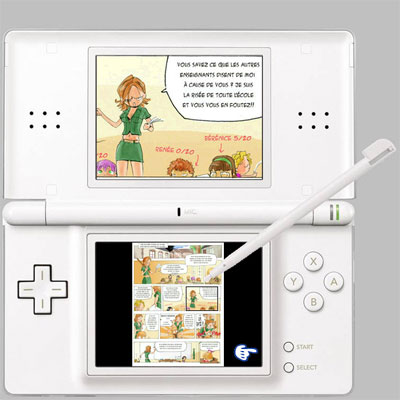
The fourth generation in the Pokemon series debuts in Japan this week, with the release of Pokemon Diamond and Pearl on the Nintendo DS. The new adventures follow the long-established Pokemon RPG formula, adding new monsters to catch and new ways to interact with other players – like Nintendo Wi-Fi support. The games are expected to sell millions in Japan, as well as here in the States – but American gamers will have to wait. Diamond and Pearl won’t be coming to other markets until next year.”
Posted by Michael Pinto on Sep 29, 2006 in Videogames
On September 29th, 1996 (ten years ago) the Nintendo 64 was released in North America, this video follows a bunch of gamer fanboys playing with the new system:
Posted by Michael Pinto on Sep 27, 2006 in Videogames
This is a very very silly game – even the opening theme song is great, it’s a parody of an 80s “Tears for Fears” song (I also love the Terry Gilliam art direction too):
Posted by Michael Pinto on Sep 23, 2006 in Videogames
This is the sad (or silly) tale of a reporter going “undercover” to do an expose on the virtual sex trade business, so I guess that would make this “virtual journalism”:
“Should I wear the black heels with the red stockings or the white heels with the pink lingerie? This is the type of question that plagued me in my “Second Life” as a working girl. A few weeks ago, I created a female avatar to research the booming sex industry inside this virtual world. I called her Darlene Sin. Why leave anything to the imagination, right?”
…so if the reporter (Derrick) was playing a girl online does that also make him a virtual cross dresser?
“Perhaps not entirely grasping the concept of escapism, Bandai, creator of the hugely successful Tamagotchi, is set to release Ant’s Life Studio in November – a virtual ant farm that requires its ‘owner’ to build nests, feed the queen and avoid getting eaten by hungry spiders.”
Captain N: The Game Master is an American animated television series that aired from 1989 to 1993. In the U.S., the show aired as part of the Saturday morning cartoon lineup on NBC. The show incorporated elements from many of the most popular Nintendo games of the time. The show was cancelled along with several other cartoons once NBC started changing its format to make more time for news programs. Criticism from government and watchdog groups that NBC’s Saturday morning lineup consisted mostly of thinly veiled commercials aimed at children also may have played a role.
“Although no official announcement has been made yet, it’s clear that Sony has plans to leverage its massive PlayStation brand equity among gamers looking at the phone market. The real question is whether the company intends to add phone functionality to the PSP, introduce an entirely separate PlayStation phone device from Sony Ericsson, or do something else entirely. According to an interview in Japan’s Nikkei BP with Sony Computer Entertainment corporate executive Izumi Kawanishi, Sony hinted that going forward the PSP may become more and more of a network device.”
Posted by Michael Pinto on Sep 4, 2006 in Videogames
This is the very first Legend of Zelda commercial in the United States for the NES (created in Japan in 1986). The commercial is pretty funny stuff, it features a vintage hip hop beat:
Posted by Michael Pinto on Sep 3, 2006 in Videogames
One of my favorite games of the CD-ROM era was Sam and Max put out by LucasArts. In an era of Doom shooters, Sam and Max was based on storytelling and characters. I also loved the fact that it used humor and has some very good writing and artwork as well. I was very happy to read that there is work being done on a new Sam and Max game, my only regret is that looking at the screen shots it seems like they are doing it in 3D, it would be nice to see if they went with a flat cartoon style: Sam and Max Are Real! A Visit to Telltale Games
“You might have surmised from reading previous entries on this very blog that I am a fan of Sam and Max Hit The Road. It’s fair to say that the classic LucasArts adventure game was “one of the defining events of my mid-adolescence,” as I put it to one of Telltale Games’ marketing gurus as he drove me from the bus station to their office in San Rafael. Oh! Did I mention that I took the bus up to San Rafael to visit the offices of Telltale Games? And saw a real live demonstration of their upcoming Sam and Max title?”
Posted by Michael Pinto on Sep 2, 2006 in Videogames
This is a neat hybrid live-action/stop-motion animation featuring a Japanese girl dressed up in a Mario outfit, riding a claymation Yoshi through the Super Mario World landscape which is populated with bottles and cans of Kirin Lemon instead of the typical coins and pipes:
Posted by Michael Pinto on Aug 21, 2006 in Videogames
I don’t know, is it me or does this game look quite lame? The trailer doesn’t quite capture what made the film so good, I mean do I care where Mr. Pink put the diamonds? Also by following the film so closely it looks like they suffer from bad game design by being too linear, but you be the judge:
Posted by Michael Pinto on Aug 16, 2006 in Tech, Videogames
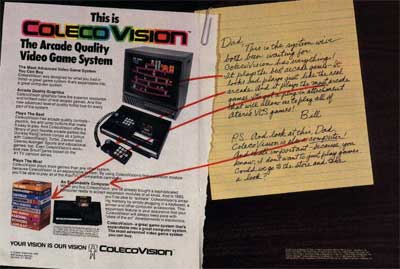
According to Wikipedia: “The Atari 2600, released in 1977, is the first successful video game console to use plug-in cartridges instead of having one or more games built in. Originally known as the Atari VCS—for Video Computer System—the machine’s name was changed to “Atari 2600” (from the unit’s Atari part number, CX2600) in 1982, after the release of the more advanced Atari 5200. It was wildly successful, and during the 1980s, “Atari” was a synonym for this model in mainstream media.”
Here’s a cool commercial from the golden age of video games:
“In the 30 years of video game development, the art of making console games has been reserved for those with big projects, big budgets and the backing of big game labels. Now Microsoft Corp. is bringing this art to the masses with a revolutionary new set of tools, called XNA Game Studio Express, based on the XNA platform. XNA Game Studio Express will democratize game development by delivering the necessary tools to hobbyists, students, indie developers and studios alike to help them bring their creative game ideas to life while nurturing game development talent, collaboration and sharing that will benefit the entire industry.
By providing an integrated, seamless development environment based on Visual Studio Express and .NET that simplifies the integration and use of game content, XNA Game Studio Express makes game development easier to accomplish for smaller projects, strongly increasing the chance for great game ideas to make it out of the concept stage and into the hands of gamers everywhere.
The XNA Game Studio Express beta will be available Aug. 30, 2006, as a free download on Windows XP, for development on the Windows XP platform. XNA Game Studio Express will give anyone with a Windows XP-based PC access to a unified development tool that liberates the creation of great Xbox 360 and Windows XP-compatible games, providing a new alternative to the existing multithousand-dollar development kits that many console games require. The final version of XNA Game Studio Express will be available this holiday season.”